
All-on-4 Dental Implants in Istanbul — Planned for a Real Second Trip
 Written byDt. İzzet İlker Aydoğan
 Medically reviewed byDt. Berre Karaöz
In short
All-on-4 in Istanbul Zeytinburnu. Honest candidacy, two-trip protocol, brand-by-brand pricing. Get your case reviewed before you fly.
Key takeaways
- All-on-4 replaces a full arch of teeth on four implants.
- At İnci Diş in Istanbul, we plan All-on-4 honestly.
- All-on-4 is a full-arch restoration where four implants — two in the front and two tilted distally to avoid sinus or nerve — support a fixed prosthesis.
The short answer first
All-on-4 replaces a full arch of teeth on four implants. It is one of the most effective treatments in modern dentistry, when the patient is a real candidate. It is also one of the most over-sold treatments in dental tourism, because "same-day teeth" makes a powerful headline.
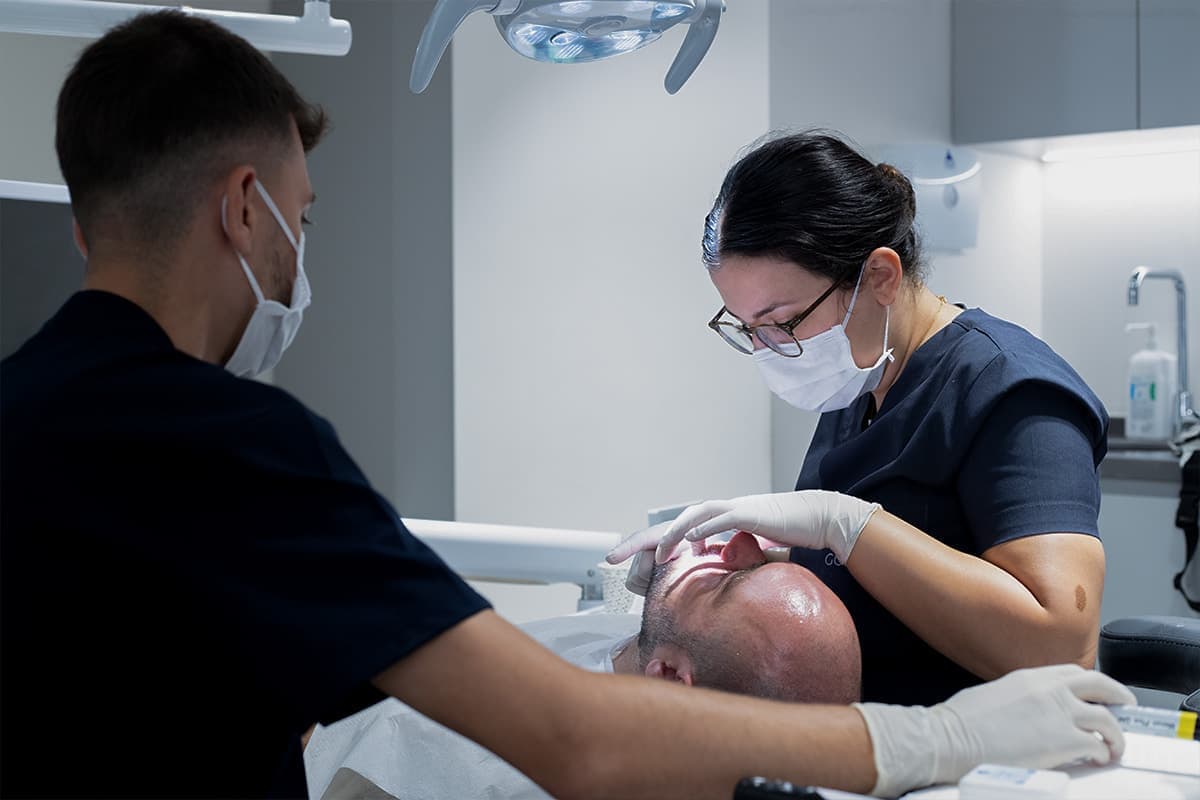
At İnci Diş in Istanbul, we plan All-on-4 honestly. That means a CBCT-based decision on whether four implants is the right answer, a clear two-trip timeline, and a temporary bridge that survives the healing period without misleading you about what comes next.
What All-on-4 actually is
All-on-4 is a full-arch restoration where four implants, two in the front and two tilted distally to avoid sinus or nerve, support a fixed prosthesis. The protocol was developed by Paulo Maló in the 1990s and has a strong long-term evidence base when applied to the right cases.
The full arch is one prosthesis on four anchors. Not four crowns on four implants.
Who is a real candidate
You are likely a good candidate if:
- You have lost most or all teeth in an arch, or your remaining teeth are non-restorable.
- You have enough bone in the front of the jaw to anchor the two distal tilted implants with primary stability (this is what allows immediate loading).
- Your bite is manageable: no extreme bruxism without a plan.
- You can complete two trips, roughly 3–6 months apart.
When All-on-4 is not the right answer
We will tell you if All-on-4 is the wrong tool:
- Heavy bruxers: four implants per arch may overload; All-on-6 with stronger material distributes force better.
- Severe posterior bone loss with no front-of-jaw bone either: may need zygomatic implants in specialist centres.
- Salvageable dentition: if several of your teeth can realistically be saved with endodontic and periodontal work, a mixed plan (Full Mouth Restoration) is often the more conservative choice.
- Active uncontrolled periodontal disease: stabilise first.
"Same-day teeth" — what is true and what is marketing
Yes, in most All-on-4 cases we attach a temporary bridge on the same day as surgery. It looks like teeth, you can speak with it, you can eat soft food on it.
No, it is not your final result. The temporary is acrylic (PMMA). Its job is to look acceptable, restore basic function, and protect the implants during osseointegration. It is not the strong final bridge.
The final prosthesis comes on Visit 2, 3–6 months later, after the implants have integrated. That final prosthesis is what you live with for the long term.
A clinic that promises "permanent teeth in 4 days" is either using "permanent" loosely or planning to fit a long-term bridge onto unintegrated implants. We do not do that.
The two-trip timeline
| Phase | Where | How long | What happens |
|---|---|---|---|
| Pre-travel | Home | 1–2 weeks | Photos, X-ray/CBCT review, video consult, written plan, deposit |
| Visit 1 | Istanbul | 5–7 days | Exam, CBCT, extractions if needed, implant surgery, temporary bridge, suture removal |
| Healing | Home | 3–6 months | Soft diet, hygiene routine, remote check-ins at week 1, week 4, month 3 |
| Visit 2 | Istanbul | 5–7 days | Abutments, intraoral scan, try-in, final prosthesis fitting |
| Year 1 | Home | — | Remote check at month 6 and year 1 |
The healing period is not optional. It is the difference between a 95%+ ten-year outcome and a fragile one.
What the temporary bridge can and cannot do
| Can | Cannot |
|---|---|
| Look acceptable in public | Survive hard or chewy foods (no nuts, crusty bread, steak) |
| Restore basic chewing of soft foods | Last more than ~6 months reliably |
| Stabilise the implants | Match the bite precision of the final bridge |
| Let you speak and smile | Be your long-term solution |
Prosthetic material — the choice on Visit 2
The final All-on-4 bridge is usually one of:
- Acrylic on titanium framework: lighter, less expensive, easier to repair, but wears faster.
- Zirconia hybrid bridge: stronger, longer-lasting, better aesthetics, more rigid (good for non-bruxers).
- Monolithic zirconia: most durable, best aesthetic stability, the choice for many bruxers in combination with a night guard.
We will tell you which material your case calls for and why. The decision is clinical, not a feature list.
Recovery and aftercare
- Day 0–3: swelling, soft cool foods, prescribed antibiotics and analgesics. Sleep slightly upright.
- Day 4–10: rapid improvement. Suture removal at day 7–10 before you fly home.
- Week 2–6: continue soft diet. No straws, no smoking, careful hygiene around the bridge.
- Month 3–6: osseointegration. Remote check-ins.
- Visit 2: final prosthesis.
- Long-term: night guard if you grind; hygienist visit every 6 months at home; annual remote check with us.
See What Happens After I Return Home.
Risks and limitations
- Failure of one of the four implants during osseointegration is rare but possible; we manage it with replacement and re-planning.
- Peri-implantitis is a long-term hygiene-dependent risk.
- Prosthesis fracture is possible, particularly in heavy bruxers: we manage it with material choice and night guards.
- Bite adjustment is normal in the first weeks after the final bridge fits.
If your case has additional risks, heavy smoking, uncontrolled diabetes, severe parafunction, we will write that into your plan rather than smile through it.
What affects your price
| Factor | Impact |
|---|---|
| Implant brand (Korean / European / Premium) | Largest single factor |
| Final bridge material (acrylic / zirconia hybrid / monolithic zirconia) | Significant |
| Extractions needed | Per-tooth add |
| Bone graft or sinus lift | Per-area add |
| IV sedation | Optional add |
| Single arch vs both arches | ~Doubles in both arches |
See Dental Implant Cost in Turkey.
Indicative All-on-4 prices at İnci Diş
| Brand tier | Per arch (EUR) |
|---|---|
| Korean (Osstem/Dentium) + acrylic bridge | €4,800 – €6,200 |
| European (Medentika/MIS) + zirconia hybrid | €6,200 – €8,000 |
| Premium (Nobel/Straumann) + monolithic zirconia | €8,500 – €11,500 |
Includes surgery, temporary bridge, abutments, final bridge as specified. Does not include grafts, sinus lift, or sedation.
What is included
- CBCT and intraoral scan
- Surgery
- Temporary bridge (PMMA)
- Abutments
- Final bridge in chosen material
- Implant passport with brand/model/lot data
- Written treatment summary and bridge letter to home dentist
- Remote follow-up calendar
- Warranty terms in writing
What is not included
- Flights and hotels
- Treatment outside the All-on-4 plan
- Replacement of a night guard lost or worn out at home
Why İnci Diş
- Two-trip planning by default, not "permanent teeth in 4 days" promises.
- The implant brand is named in your plan, before quote.
- CBCT decides candidacy. No quote without imaging.
- We will say no when six implants, zygomatic referral, or a conservative plan is the correct answer.
- Aftercare is a written protocol: implant passport, scheduled check-ins, bridge letter to your home dentist.
Risks the brochures usually skip
Implant work has a known safety profile, but the marketing copy in this category leaves out the parts that actually decide outcomes. We would rather you read them now than find out later. Peri-implantitis (bacterial inflammation around an implant) is the dominant long-term failure mode and it is preventable with consistent hygiene. Upper-back implants approach the maxillary sinus and lower-back implants approach the inferior alveolar nerve, which is why we do a CBCT before every case rather than a 2D panoramic only. Smoking, uncontrolled diabetes and grinding without a night guard each push the failure rate noticeably above baseline, and those are factors you control after you fly home.
What you carry home in your implant passport
Every implant we place is logged on a one-page implant passport that flies home with you and a copy goes to your home dentist. It names the brand and exact model (for example, Straumann BLT 4.1 × 10 mm SLActive), the lot number, the surgical date, the abutment torque, and the restoration material. If anyone ever asks what is in your mouth, the answer is on one page in writing. Most clinics do not provide this and it is the single most useful document to keep.
- Implant brand and model, with diameter and length per site.
- Surgical date and the named clinician who placed each implant.
- Manufacturer lot numbers (so the implant body is traceable for warranty).
- Final crown or bridge material, shade and date of fitting.
- Recommended hygiene recall cadence with your home hygienist.
Frequently asked questions
Surgery is done under local anaesthesia, with IV sedation available. Most patients describe the first 48 hours as moderately uncomfortable, well-managed with prescribed medication. By day 4–5 most are eating normal soft food.
Implants are intended to last decades. The bridge attached to them is a serviceable component, acrylic 5–10 years typical, zirconia 10–20+ years typical, with maintenance.
Generally we prefer day 5–7 so sutures can be removed and the first review done before you leave Istanbul.
Sometimes, All-on-4 was designed for atrophic jaws. But there are cases where All-on-6, zygomatic implants, or staged grafting is the correct decision. CBCT decides.
You will see both options in writing, with the clinical reasoning. See All-on-6 in Turkey.
Summarise this article with AI
Open the article in your AI assistant for a quick summary, or to ask your own follow-up questions.
Let Us Contact You
Discover the best version of yourself with personalized aesthetic solutions. Feel confident and comfortable in your own skin with our expert team and advanced treatments.
Get A Free Consultation
Read our Blog